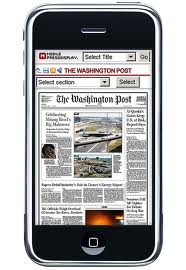
85% of Magazines and Newspapers are Available Online

newspaper magazine iphone android cell phone online legal marketing law firm marketingAs law firm marketers contemplate their advertising buys, we should be aware that the audience for newspapers and magazines has moved online. For example, before buying a $12,000 full-page ad in a print publication, it makes sense to see if there is a cheaper online option -- which will reach more people.


The Audit Bureau of Circulations recently conducted a survey of print publications—newspapers, magazines and b-to-b titles—to learn how their mobile initiatives are progressing. Publishers’ growing mobile know-how, increasing confidence in mobile strategies, maturing product offerings and anticipation for future revenue streams is evident in the results.

  • Eighty-five percent of survey respondents said they currently have mobile content for smartphones, e-readers or tablet computers, up from 76 percent last year. Newspapers (88%) were most likely to have mobile initiatives in place, followed closely by consumer magazines (83%) and business publications (79%). Publishers cite development and maintenance costs as the primary reason they did not have a mobile presence.
  • Publishers are gaining confidence in their mobile strategies. Fifty-nine percent of publishers now say their company has a strategy for capitalizing on mobile platforms.
  • Many publishers believe that e-readers and tablets will be the biggest boon to their business. Seventy-three percent said readers are most likely to read  their content on e-readers or tablets compared to 60 percent who said the same thing about smartphones. In Canada, the gap was even wider. Fifty-seven percent said e-readers and tablets had the brightest future compared to just 34 percent for smartphones.
  • Publishers in the U.S. and Canada are investing in optimized mobile websites. Eighty-one percent of U.S. publishers and 65 percent of Canadian publishers said this was an important part of their strategic plan. Respondents said mobile websites often account for up to 15 percent of their overall website impressions.

Marketing takeaway: when you have a case outcome, completed deal or hot legal news story, conduct at Google search to find the newspapers and magazines to offer the story to.


4 Things You Need to Know to Protect Your Online Reputation

The infographic below from Mashable describes:

  1. What's an e-reputation.
  2. Why your online reputation matters.
  3. What potential employers are looking for.
  4. What you can do about it. Feel free to check out my PowerPoint slide show "How to Monitor & Enhance Your Reputation on the Internet as a Lawyer."

protecting your online reputation, blog, facebook, google, twitter


Tune up Your Online Bio So it Attracts More Leads

Your online bio is the cornerstone of all your online marketing efforts. No matter whether you're active on LinkedIn, Facebook, YouTube or Twitter, how you describe yourself will determine whether your bio generate leads.

The trick to making your bio attract more leads is to turn your 30-second commercial into your bio. Describe (1) who you are (2) whom you work with and (3) what problem you solve.

Law Firm Marketing: Facebook is Top Spot for Display

online social networking, law firm marketing, legal marketingFrom JusticeNewsFlash.com:

Facebook has clinched the top place for online advertising as the social media giant has captured 23 percent of all Internet display ads, resulting in 297 billion ad impressions, which is higher than the total of all display ads on Google, Microsoft, Fox and Yahoo sites combined.

The astounding numbers, wallet-friendly prices and Facebook’s ability to target specific audiences have catapulted Facebook to the number 1 position for display ads. Yahoo came in second with 140 billion display ad impressions, followed by Microsoft at 64 billion and Fox Interactive Media at 48 billion. Google came in last at 35 billion ad impressions, according to the ComScore third quarter report.

So what sets Facebook apart from the other Internet publishing sites? Three things: socializing, price and Facebook’s ability to target its audiences. People spend an average of 700 billion minutes a month on the social networking site, and with over 500 million active users, the potential consumer impressions can be tremendous.

“Facebook’s increasing share of the display ad market probably resulted from the company’s fast-growing audience size, an increase in the number of ads per page that Facebook delivers and an increase in the amount of time that users spend on its website. The more people in your social network that are online, the more value it creates to you as a user, the more you are likely to engage and contribute,” stated comScore’s Andrew Lipsman.

Facebook online display ads sell at a big discount when compared to sites like Yahoo and Microsoft. The CPM (cost per thousand impressions) for Facebook’s U.S. display ads runs at about $1, compared to a $3 CPM for display ads on U.S. Yahoo sites. The discounted pricing is appealing for people who are looking to make a big impression on a small budget.

Facebook also has a unique feature that allows the social network to target the exact demographic they are looking for. The age, sex and interests all factor into what ads will appear on user’s Facebook pages, which ensures your ad will be seen by the right audience.

Facebook is an ideal place for law firms who are looking to get more “bang for their advertising buck.” Not only can your law firm save a little bit of cash while still achieving a high dollar audience reach. But, remember, keep the ads engaging and “worth the look” for consumers; generation Y are heavy users of Facebook and your attorney’s potential clients.


"Martindale Connected" Social Network Grows 10X in One Year

Martindale Connected, an online social network for lawyers, has grown from 3,000 lawyers when it was launched one year ago to 30,000 members, including members from more than half of the Fortune 500, lawyers from 98 of the Am Law 100, and 10 Alliance Partners from prominent legal organizations and associations.

To date, almost 700 active groups have formed within the community, where members collaborate and share ideas on a number of legal issues, and 2,500 members have participated in community-hosted webinars.

From my own personal experience I can tell you it's a lively group of people led by energetic community leaders. LinkedIn may be 100 times bigger, but the discussions don't go anywhere.  In contrast, the discussions on the more intimate Connected are 100 times more active.

Among other things, Connected has led me to:

  • Have a live video interview using Skype with community leader Mike Mintz, who was 5,000 miles away in Jerusalem.
  • Get the opportunity to lead a live online discussion of virtual law firms on Twitter.
  • Met the wonderful people in the Virtual Law Firms group, including Richard Granat, Stephanie L. Kimbro, Joseph Walsh, Alan Wernick, whom I knew "IRL" (in real life), Donna Seyle and many others.

Martindale Connected 

Lawyers Can Find Referrals on ABA Online Social Network

News Alert: the ABA has launched an online social networking site – Legally Minded – at LegallyMinded.com

ABA Legallyminded, law firm marketing, business development 


Benefits include:

  • It offers ways for lawyers to generate referrals by making connections online.
  • One twist is that it has a “people map” that displays other members who have similar interests, or are looking for what a lawyer has to offer.
  • It’s free.
  • No ABA membership required. It’s public.
  • You can view most of the site without having to register.
  • There’s less “noise” than you’ll find on LinkedIn and Facebook.

It’s a “public beta” site, so the ABA is aware it’s not perfect. Full details are now available on the LawMarketing Portal at http://www.lawmarketing.com/pages/articles.asp?Action=Article&ArticleCategoryID=7&ArticleID=831