Am I making the right business choice?

Today's post is a by a guest author from LFS Legal, Belinda J. Darling.

Running a business of any kind- be it a hairdressing salon, a media monitoring business or a national chain of furniture shops- entails making multiple decisions every day. Some of those decisions have small consequences- who is going to man the phones while the receptionist takes his break?- while others have much larger and far reaching consequences. Learning how best to approach the decision making process will mean your business runs in a more harmonious and productive manner.

Many of the business choices you’ll face will involve staff. People managing is a tricky business but with a considered and respectful approach, you’ll create a positive and proactive working environment. Let’s look at some examples of the types of decisions you might face. Your chief sales manager is good at her job- but it’s fast becoming apparent that her skills and knowledge would be better suited to a marketing role. You can see that installing someone else in the sales role would boost revenue, while utilising the skills of the sales manager in the marketing department would be beneficial in drumming up new business. The problem is, your sales manager loves her job and has never registered any interest in switching departments.

The key here is to make your sales manager feel she’s an invaluable member of the team. It’s been repeatedly established in studies of the workplace that employees thrive when they feel valued. Suggesting to your sales manager that the marketing role needs HER unique contribution will help her understand and accept that rather than being pushed out of her job and cornered into another role, her talents are being recognised and her skills put to use accordingly. To learn more about making the right business choice, get in touch with the experts at LFS Legal.

The benefits of making the right business decisions, particularly where your employees are concerned cannot be overstated. Happy employees work harder, feel personally invested in the business, and have better retention rates.


Tags:

Survey Finds Slow Adoption of Alternative Fee Arrangements for Legal Services

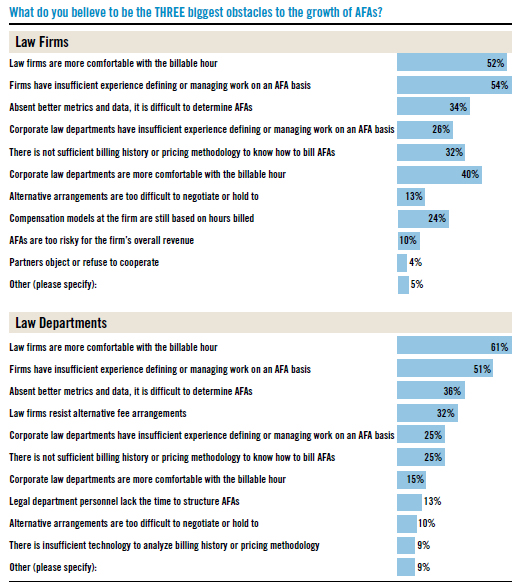
lexisnexis, law firm marketing, attorney feesThis just in from ALM: In spite of all the buzz, an increase in use of AFAs proving much more gradual than forecast in aftermath of 2008-2010 recession. [See the chart below for the reasons behind the slow adoption of AFAs.]

According to results from a new survey conducted by ALM Legal Intelligence, alternative fee arrangements (AFAs) for legal services -- billing methods based on metrics other than an hourly rate – are becoming more pervasive, but still failing to gain the traction that was predicted by industry experts in recent years.

The survey report, “Speaking Different Languages: Alternative Fee Arrangements for Law Firms and Legal Departments,” indicates that only 6 percent of law firm respondents used an AFA in 2011 for more than half of their legal work last year, with the majority (67 percent) using AFAs for less than one quarter of their billing. Similarly, only 12 percent of legal department respondents said they used AFAs for more than half of the legal work they assigned to outside counsel in 2011.

Perhaps even more telling about the lackluster adoption of AFAs is that 6 percent of legal departments and 17 percent of law firms did not even know what percentage of their legal work was billed using a method other than the billable hour or discounting.

These results are among the thought-provoking findings of the survey, which was conducted last month by ALM Legal Intelligence and sponsored by LexisNexis® CounselLink®. To download a free copy of the report, please go to http://almlegalintel.com/Surveys/AFAreport.

“To get an all-around and fresh take on the adoption of AFAs, we connected with more than 200 law departments and more than 200 large law firms in the U.S.,” said Kevin Iredell, vice president of research and continuing education products at ALM. “The results of this survey suggest that the billable hour remains entrenched, despite widespread reports that clients are dissatisfied with the practice. However, we also found that the vast majority of both corporate legal executives and law firm partners expect the adoption of AFAs to continue to rise in the next five years.”

According to Iredell, other highlights of the survey findings included the following:

  • Law firms’ and companies’ opinions differ as to who they think is responsible for the lag in AFA adoption.  According to law firms, the top obstacle to increased use of AFA billing focuses on either side feeling more comfortable with hourly billing in general.  Legal departments agree, but they go on to find lack of experience in defining and managing work and billing matters on a basis other than hourly as big a stumbling block for both parties.
  • Despite the slow adoption rate, the use of AFAs is clearly growing. About 62 percent of law firms saw an increase in the use of AFAs in 2011, with only 2 percent citing a decrease and the remainder seeing no change. Half of legal departments saw an increase, with 49 percent saying that the number remained the same and only 1 percent that experienced a decrease.
  • The top three choices for types of alternative fee arrangements used by both firms and departments were: flat fee (89 percent of departments, 93 percent of firms); blended rate (47 percent of departments, 89 percent of firms); and capped fee (57 percent of departments, 83 percent of firms)
  • About 70 percent of legal department responses predicted an increase of AFA use from 2012 to 2016, with 26 percent thinking the amount will stay the same and just 4 percent expecting a decrease. Almost three-quarters of law firms (74 percent) expect an increase in AFA work over the same time period, while 14 percent think that things will be the same and, again, just 2 percent expect a decrease.

“Both corporate counsel and law firms continue to struggle to find ways to make alternative fee arrangements work for them,” said Kris Satkunas, director of Analytic Consulting for LexisNexis CounselLink. “LexisNexis has developed advanced solutions to help both law firms and corporate legal departments identify the types of matters that best lend themselves to AFAs, to model different fee arrangements and pricing scenarios to achieve better cost predictability, and to track performance throughout the lifecycle of the engagement.”

alternative fees, law firm marketing, attorney marketing, legal fees

Tags:

How Much Law Firm Media Professionals Earn

LFMP YEAR-END SPECIAL EVENT—THE WORLD TRADE CENTER

When: Wednesday, June 20, 2012 from 5:30 - 8:00 p.m.

Where: 7 World Trade Center, 250 Greenwich Street


Join us at The World Trade Center, where we will gather, earlier than usual, to hear a few words from one of the project leaders about the iconic site, enjoy cocktails and light snacks and then have the opportunity to visit the stunning, celebrated Memorial Garden.


Click here to RSVP

A compensation survey conducted jointly by the Law Firm Media Professionals and Hellerman Baretz Communications revealed that the average salary among all respondents was $130,391.

This is down nearly $8,000 from the 2010 survey. The most interesting findings of the survey included:

  • Only 59% received a raise, as compared to 76% in 2010.
  • West Coast and Northwest respondents had the highest average salary: $160,000. Respondents from the Northeast reported an average salary of $133,627.
  • $135,650 is the average salary for a respondent whose firm budgets for social media, compared to $132,643 for a respondent whose firm doesn’t budget for social media.
  • $152,582 is the average salary for a respondent whose firm uses an outside PR/communications agency, while that of respondents whose firm doesn’t use an outside PR/communications agency was $102,535.
  • $132,047 is the average salary for a respondent whose firm maintains at least one blog ($150,720 for those who blog three or more times a week), while that of respondents whose firm doesn’t maintain a blog was $125,322.

The survey was conducted from February 13 to February 24, 2012. LFMP members were polled, and there was a total of 76 respondents. Zoomerang.com collected the confidential data, which was analyzed using Microsoft Excel and third-party analytics software.

Full details are in the Law Firm Media Professionals / Hellerman Baretz Communications Compensation Survey.


Tags:

Big Firm Litigators Heading to Boutiques


Ward Bower
I picked up this story on the Texas LawBook. The move by big firm litigators heading to small firms is caused by of conflicts, clients unwilling to pay big-firm rates and the ambience of smaller offices.

In-house counsel, legal recruiters and law firm management experts say there is a fundamental shift in the practice of business litigation in Texas. More than 40 large firm partners and associates in Austin, Dallas and Houston made lateral moves to litigation boutiques during the first four months of 2012, according to research by The Texas Lawbook.

Texas Lawbook says that big law firm litigation sections have been slowly shrinking during the past decade. Some are half the size they were in 2000. Meanwhile, litigation boutiques, which often specialize in areas such as employment law, intellectual property or securities matters, are booming.

Affected big law firms include:

  • Vinson & Elkins
  • Fulbright & Jaworski
  • Locke Lord

“Major corporate firms are seeing clients take their litigation work to litigation boutiques, and the lawyers at those major law firms are leaving to follow the work,” said Ward Bower, Altman Weil principal and consultant.

Businesses such as AT&T Inc., Dell Inc. and energy companies have become increasingly sensitive to litigation fees.

“Most large, full-service law firms have overpriced themselves, and most businesses simply cannot afford $800 or $900 an hour,” said Michael Lynn of Lynn Tillotson. “We’ve deliberately priced ourselves at $650 an hour, and we clearly are not starving. We are busier than we have ever been.”

He gets about 30 résumés a year from lawyers at large law firms who want out.

“The two primary inhibitors to business development for a litigator at a major law firm are inflexible rate structures and client conflicts of interests,” said Sherrard “Butch” Hayes, former Fulbright parner-in-charge, now a partner at Weisbart Springer Hayes in Austin.

Legal recruiters and consultants told Texas LawBook that few of these lawyers are pushed out of their large corporate firms. But the firms aren’t necessarily begging them to stay, and they certainly aren’t replacing them with other litigators.

Tags:

US Law Firms Earned $7 Billion from Alternative Fee Arrangements

One of the elements demonstrating that the legal profession has changed permanently in the last five years is that the 100 top-grossing US law firms earned approximately $7 billion from alternative fee arrangements (AFAs), according to a new white paper “The Evolution of the Legal Profession.”

Written by Ari Kaplan, Principal of Ari Kaplan Advisors, the paper is based on interviews with 30 lawyers, in-house counsel, law professors and other legal experts. “By relying more heavily on alternative billing arrangements than we ever have before, we were able to bring in a lot more work,” said Crowell & Moring’s chairman, Kent Gardiner. Arent Fox, Akin Gump and Skadden Arps also derived income from unconventional billing.

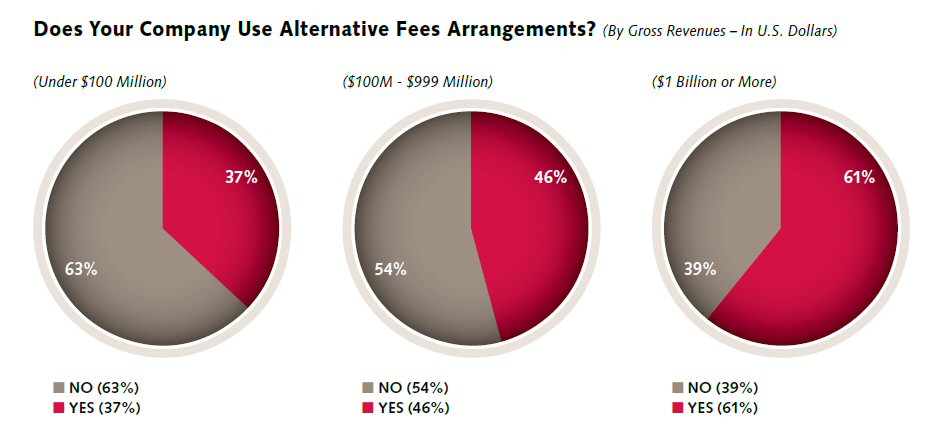
According to Fulbright’s 2011 Litigation Trends Survey Report, 52% of US companies are using AFAs. Companies with bigger gross revenues use them to a greater extent. Lower costs are the overwhelming reason for using AFAs, followed by their predictability.

Company use alternative fees, afas, law firm marketing, legal marketing

Law firms and corporations are still not focusing enough attention on creating efficiencies in internal processes, according to Beth Anisman, a consultant with B&Co. and former Global Chief Administrative Officer for Legal of Lehman Brothers.

Some efficiencies, such as software that reviews e-discovery, have actually eliminated the need for thousands of junior associates, who have been laid off.

To maximize their value, lawyers need to focus on prior work produce and experience as opposed to solely billing hours, according to Jeffrey W. Carr, General Counsel of FMC Technologies.

There’s no looking back, according to the report. 74% of the respondents agreed that the changes will be permanent.


San Francisco Does Lawyers a Favor and Bans Yellow Pages Distribution

yellow pages dumpters, law firm marketing, legal marketing, lawmarketing"Mass over-distribution of Yellow Pages has degraded our environment and blighted our neighborhoods," said San Francisco Board of Supervisors President David Chiu, the lead sponsor of a law banning the unsolicited distribution of Yellow Pages.

For years I've been annoyed with the dumping of various yellow pages on my lawn, like so much trash. The delivery people don't even both to hang it on my door knob.  I use Google instead as does the rest of the world, and I use the yellow pages only for seat cushions and door stops.

For years I've advised lawyers not to advertise in the money-wasting yellow pages. I think the San Francisco mayor and the Board did lawyers a favor, by demonstrating that the yellow pages are considered to be composting matter. Under the law, which won't go into effect for a year, companies cannot leave the directories at the front doors of residences and businesses without prior permission.

Overall U.S. yellow pages revenue declined 11.8% in 2010.  The industry’s revenue slide continued in 2010 as the transition from print to digital products continued, according to Simba Information. This marks another year of continuous, multiyear double-digit losses in revenue from the major publishers.

National yellow pages spending is projected to decline an additional 12% to $1.47 billion in 2011. Simba believes that the current environmental challenges are a “ticking time bomb” threatening the industry with increased government-imposed controls and “do not deliver” lists scattered around the 50 states.

As I wrote in 2007:

Cancel that #*$%! expensive yellow pages ad.  This was the clear advice I gave to attendees at our conference "Developing Your Personal Marketing Plan" in Chicago.  I repeated the advice at the Chicago Bar Association technology conference.  You now have permission to save yourself a small fortune.

Fewer people are reading the Yellow Pages every day. It's last century's marketing. Instead, they are using the Web to find attorneys. Take the money you save and plow it into your online presence.  People now use Google to look up phone numbers, addresses and law firms.

Ask yourself -- when was the last time you personally opened that thick, hard-to-read yellow directory?  It's been a long time, hasn't it? There are multiple yellow page directories anyway -- which one did you use?

By advertising in the yellow pages, you are doing what thousands of other lawyers are doing.  You are simply making yourself more like the competition, not distinguishing yourself. There's no way to break from the clutter -- there are hundreds of lawyer yellow page listings.

Besides, most yellow pages ads are written by their salesmen.  That's why they all look the same. Save your budget while you still can. Get out now.

What Lawyers Earn: Find Yourself on the Chart

Lawyer salaries, How much lawyers makeThe following chart is from the 2011 Salary guide published by Robert Half Legal.  Find yourself on the chart and see if you are earning as much as you should be.  Please go to http://www.roberthalflegal.com/salarycenter to use the company's salary calculator.


Information in the guide is derived from a wide range of sources, including:

  • Thousands of full-time and interim placements made by Robert Half across North America
  • Local insight from our staffing and recruiting professionals throughout Robert Half's branch network
  • Exclusive workplace research Robert Half conducts regularly among senior lawyers with the largest law firms and corporate legal departments in the United States and Canada
  • An analysis of the hiring environment and an extrapolation of current trends into 2011.


Tags:

McKenna: The Demand Side of The Market is Not Demanding AFAs

Patrick McKennaFollowing is a post by Canadian strategist Patrick J. McKenna on his Rants and Raves blog and picked up by LegalOnramp. His comments that "value billing" is a revolution, but nobody came, are new evidence reported in articles on the LawMarketing Portal such as:

We keep reading editorials about how the “clients are driving change” and one in today’s Financial Post about how the “clock is ticking on hourly billing.” Then from certain consultants come dire warnings about the potential obsolescence of law firms whose leaders are too clueless to see and react to the changes in the market. On September 14, New York will host a one-day event entitled: The Client’s Revolution. What you should be demanding from your legal advisors in the 21st Century.

Client revolution indeed! Among all of this one sees a lot of smoke, but . . . where’s the fire?

Regular readers of my blog may remember my rant (#396) back on June 30 of last year, entitled: CLO’s Are Not Serious About Change.   In that post I reported on an interesting experience working on behalf of an AmLaw listed, “Go-To” regional firm of over 500 attorneys. I spent two weeks initiating contact with the General Counsel of more than 35 Fortune 500 Companies to explore their interest in investing one-hour to meet.  The invitation was to discuss how this particular law firm could provide exceptional client service and deliver a potential savings of between 25 to 40 percent, or more.   And that proposed savings was accompanied by specific details of guaranteed responsiveness, assured predictability, enhanced added-value, and references from some top New York based Fortune 50 existing clients. To my absolute chagrin, I confessed in my post that I completely struck out! No bunts, no hits, not even a sniff of interest. I subsequently heard back from a couple of GC’s via Legal OnRamp that . . . “unfortunately, change comes slowly.”

Alex Novarese, Legal Week, law firm marketing, AFAsWell, fast forward a year and here’s an editorial from Alex Novarese at Legal Week, wherein Alex postulates that maybe someone called for a revolution but nobody came.

The harder I look at the profession the more convinced I become that clients - the demand side of the equation - are not only generally failing to enforce change, they are, if anything, more conservative than the law firms, which is saying something. What evidence is there that all but a few brave pioneers have even tried to make good on that vision? A financial crisis and a deep recession has hit Western economies and little has changed beyond a modest uptick in alternative billing. The internet? Disruptive technologies? Such trends have unquestionably forced more transparency onto the legal profession and in theory should give clients scope to take control of buying legal services. But, as yet, there has been little to back up the hype in terms of shaking up the industry or empowering clients.

Alex continues . . . outsourcing, offshoring and attempts to unbundle legal service provision - experiments in these areas are being pushed more by managing partners than pulled by clients. It was the same in earlier years when law firms went international, which was as much a strategic bet taken by the profession as a response to client demand. 

As an explanation for this lack of urgency, one commentator suggested: Unlike the management in law firms, GCs don't change every few years - they stay in leadership posts and maintain old practices. Change will take time, but perhaps it will require a generational change inside the in-house world to really make a difference.

Perhaps the real mystery is why clients are quite so ready to tolerate the status quo.  Why do some GCs make a show of complaining about the cost of legal services when they do almost nothing to materially change things?

As yet another commentator opined: Perhaps, moaning about fees gives a sense they are responding to the predicament they are in, effectively signing blank checks for legal services on behalf of their company. But, the alternative - to do something about it, is not a strong enough driver for many GCs. One has to ask, what is the benefit to the GC in annoying law firms by driving down prices, demanding fixed fees, or insisting on other non-traditional methods? For many there is none. No one in the company is second-guessing the GC’s decisions, they can maintain the status quo unchallenged. The law firms they work with are doing all they can to assure the GC that the legal spend is justified. The GCs themselves are busy, have a team to worry about, and ultimately they are spending other people's (shareholder’s) money, not their own. For most GCs their salary is not directly linked to how efficient or inefficient their legal spending is. 

In summary, there is little incentive to change business practices unless it benefits you. For many GCs the positive / negative impacts are still too slight. They are in an accountability blind spot and few have someone going over their spending decisions with a critical eye. Most CEOs worry about their company winning the litigation, not whether the legal spend has risen by another “x” percent this year. It all makes one wonder: 'Who will put pressure on the GC to change?'

I remember an engagement that I was involved with in the early 90s with McKinsey & Company. It involved helping “re-engineer” the legal department of a Canadian-based, international conglomerate to determine which law firm or combination of firms offered the best value proposition. Their strategic decision was whether to continue with the internal legal department as is, or whether they should shut down their internal legal capability and outsourcing all of the work. Only after the decision was made and the outside law firms were chosen did it occur to me that a couple of the choices of firms made, were not based on value at all, but were safety chutes for certain senior lawyers who would be remaining as employees within the legal department, should they ever decide or be forced to go back into private practice.

In the end things will change. Corporate behavior will slowly evolve; more CEOs and shareholders will take notice of legal spend as it grows and grows; GCs will adopt new practices simply because they don't want to stand out as someone who is not following what has become 'best’ practice. Things will change, but on the client side, it may yet be a long, protracted process.

Tags:

Portfolio billing: A valuable option for solos, small firms

Patrick LambFrom and article by Correy E. Stephenson, Esq., Associate Editor of Lawyers Weekly: "Solos and small firms looking for ways to attract new customers and stabilize their income should consider an increasingly popular option: portfolio billing.

"Portfolio billing is an arrangement where a law firm takes on all the legal work – or a specific subset of legal work, like all employment litigation, for example – for a client at a flat fee, explained Larry Bodine, a business development advisor at Chicago-based Larry Bodine Marketing and owner of the site www.LawMarketing.com.

"The arrangement offers benefits for clients – pre-determined legal costs – as well as law firms – predictable income.

"The trend began with larger firms, like Shook, Hardy & Bacon, which agreed to handle all of Tyco, Inc.’s product liability litigation, and Orrick Herrington & Sutcliffe, which represents Levi Strauss & Co. in all non-intellectual property issues.

"But this form of alternative billing is also a viable option for smaller firms and even sole practitioners.The following are some of the issues to consider when crafting a portfolio billing agreement:

  • Define the scope.
  • Consider resources.
  • Historical costs.
  • Time period.
  • Trust and communication.

Patrick Lamb, a partner at the nine-member Valorem Law Firm in Chicago, agreed.

Lamb and his partners started Valorem in January 2008 with an alternative billing philosophy, and he estimated that roughly 30 percent of the firm’s work is done as part of a portfolio billing agreement.

“Portfolio billing is a great thing for small firms and solos,” he said. “It smooths out bumps and provides predictable revenue flow, so you can meet payroll, pay rent, etc. And it allows you to offer value to clients.”

For the full article, please go here.

Tags:

More Law Firms Hiring Laterals to Build their Clientèle

law firms hire lateralsLateral hiring in the legal profession increased 28 percent from April to May — the highest percentage growth since the turn of the calendar year, according to Law360.

In May, a total of 202 partners, shareholders, of counsel, special counsel and managing partners moved to new firms, as compared to the 158 lateral moves in April. This is important an important tactic in business development, because the primary reason a firm hires a lawyer laterally is for the book of business they bring with them.


Lateral movement grew 1.5 percent in March over February, to a total of 202 lateral moves. The slight increase came after a 15 percent rise in February, which followed a 153 percent spike in lateral moves between January and December, according to Law360.


Among the big law firms:

  • Baker Donelson Bearman Caldwell & Berkowitz PC was the big winner in May, scoring 11 laterals.
  • DLA Piper and Reed Smith closely followed, snagging 10 and nine laterals, respectively.
  • Greenberg Traurig and Jackson Lewis both brought on seven laterals in May
  • Foley & Lardner and White and Williams lured six laterals and Hunton & Williams brought in five.
  • Jones Day, Mayer Brown and Shipman & Goodwin each snagged four laterals.
  • The firms adding three laterals were: Baker & McKenzie, Eckert Seamans Cherin and Mellott, Hogan Lovells, K&L Gates, O’Melveny & Myers, Reinhart Boerner Van Deuren, Taft Stettinius & Hollister, White & Case and WilmerHale.

Corporate finance and securities, which saw 37 laterals switch firms, were the practice areas that experienced the most movement. The area of intellectual property saw 25 laterals change firms, and 22 insurance laterals moved.


The employment and energy practice areas both had 17 laterals pack their bags. Other practice areas with a lot of shake-ups included real estate, which experienced 13 moves; health, which had 12; and financial services, which had 11 lateral moves.

Tags: